



 Updated on Jul 20, 2026
What is vibe coding? This term refers to a new way of building software. You describe what you want in plain English. Then an AI tool writes the code for you. This approach took off in 2025 and is now changing how companies build products.
In Singapore, startups and SMEs are already using it to ship MVPs within days. But speed comes with questions. Is vibe coded software secure? Which tools should you trust? Can it replace your development team?
This guide from TechTIQ Solutions answers all of these questions. We explain the vibe coding meaning, compare the most popular tools, cover the key security risks, and show you how to start the right way.
Key Takeaway
- Vibe coding is prompting AI to generate code from plain language instead of writing it manually.
- Use coding tools like Claude Code, Cursor, Replit, and Bolt to turn an idea into a working prototype within hours.
- Apply the method to prototypes, MVPs, and internal tools only. Keep customer data, payments, and regulated systems with professional developers.
- Review all AI-generated code for security flaws such as hardcoded credentials and missing input validation before launch.
- Check PDPA compliance before any app built this way collects personal data in Singapore.
What Is Vibe Coding?
Vibe coding is a software development method that refers to the practice of prompting AI to generate code rather than writing it manually. You describe the outcome you want in natural language. The AI writes the code. You test the result and refine it with follow-up prompts. You do not need to write or fully understand the code yourself.
Here is a simple example. You type: “Build a landing page with a contact form that sends submissions to my email.” The AI generates the full code in seconds. You run it, see the result, and ask for changes until it looks right.
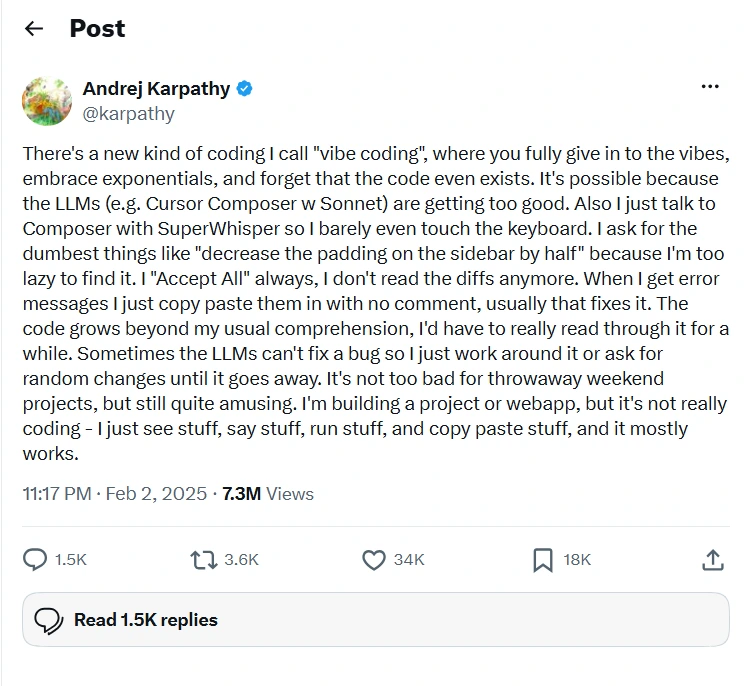
The term was coined by Andrej Karpathy in February 2025. Karpathy is a co-founder of OpenAI and the former AI director at Tesla. In a post on X, he described a new way of coding where you “fully give in to the vibes” and “forget that the code even exists.” His post went viral. Within weeks, vibe coding became one of the most discussed topics in tech.
The rise of this term reflects a bigger change in software development. The industry is moving from strict manual coding toward intent-driven development, where developers focus on describing what the software should do rather than writing every line themselves. AI coding tools handle the translation from intent into working code, and this shift sits right at the front of that change.
The 4 Main Benefits of Vibe Coding
Vibe coding offers four clear benefits for businesses. Each one solves a real problem that slows down traditional software projects.
1. Faster time to market
Speed is the biggest advantage. A prototype that used to take weeks can now be built within hours. With the best tools, you can turn an idea into a working demo in a single afternoon. This speed lets you test your product with real users sooner and adjust your direction early.
2. Lower development costs
Vibe coding reduces the cost of early-stage development. You do not need a full team to validate an idea. A small business can build an MVP, show it to customers, and collect feedback with minimal spending. If the idea fails, the loss is small. You only commit to a bigger budget once the concept is validated.
3. A lower barrier to building software
You no longer need a coding background to create working software. A founder can build a prototype alone. A marketing team can create internal tools without waiting for developers. This is why the trend is spreading beyond tech companies into every industry.
4. Focus on the problem, not the tech stack
Traditional projects often get stuck in technical decisions. Which framework should we use? Which database fits best? Vibe coding removes this burden. You describe the problem you want to solve. The AI handles technical choices. Your energy goes into the product and customer experience.
One note before you go all in. These benefits apply best to prototypes, MVPs, and internal tools. Software that handles real customer data needs proper engineering review.
Vibe Coding vs Traditional Coding: What Is the Difference?
Vibe coding vs traditional coding is not a battle where one side wins. Each approach fits a different stage of building software. The table below shows the key differences:
| Aspect | Vibe Coding | Traditional Coding |
| Who writes the code | AI generates it from prompts | Developers write it by hand |
| Speed | Working prototype within hours | Weeks or months per project |
| Skill required | Clear communication, basic tech sense | Programming expertise |
| Code quality | Varies, needs review | Controlled through standards and reviews |
| Security | Often weak without expert review | Built in through secure coding practices |
| Maintenance | Harder, code may lack structure | Easier with documented, structured code |
| Cost | Low upfront | Higher upfront, lower long-term risk |
| Best for | Prototypes, MVPs, internal tools | Production systems, customer data, scale |
The pattern is clear. Vibe coding wins at speed and cost at the start of a project. Traditional software development wins on quality, security, and maintenance over the long run. Speed also comes with a hidden cost. A faster cycle skips the review points where bugs and security gaps get caught.
What Are the Best Vibe Coding Tools in 2026?
The market now offers dozens of AI coding tools. Each one fits a different type of user and project. Here is a quick overview:
| Tool | Best For | Pricing |
| Claude Code | Complex projects, agentic workflows | Paid, from $20/month |
| GitHub Copilot | Teams already working on GitHub | Free plan, paid from $10/month |
| Cursor | Developers who want AI inside their editor | Free plan, Pro from $20/month |
| Replit | Beginners, building apps in the browser | Free plan, paid from $20/month |
| Bolt | Fast web app and website building | Free plan, paid from $25/month |
| Gemini and Google AI Studio | Free experimentation, Google ecosystem | Free tier available |
Claude Code
Claude Code is a strong choice for serious projects. It runs in your terminal and works like an agent. You give it a goal, and it plans the steps, writes the code, and tests the result. Many developers consider it the best AI for vibe coding on complex tasks. It also works in the chat interface, where you can build and preview small apps directly.
GitHub Copilot
GitHub Copilot is Microsoft’s AI assistant for developers. It suggests code as you type and can complete whole functions. Copilot fits teams that already manage their code on GitHub and want AI to help inside their existing workflow.
Cursor
Cursor brings this approach inside a full code editor. The tool suggests changes, edits multiple files, and understands your whole project. It suits users who have some coding experience and want more control over the output.
Replit
Replit is popular with beginners. Everything runs in the browser, so there is nothing to install. You describe your app, and the built-in AI agent creates and deploys it. This makes Replit one of the easiest vibe coding platforms to start with.
Bolt
Bolt focuses on speed for web projects. You type what you want, and Bolt generates a working web app you can publish right away. This makes it a strong vibe coding website builder for landing pages, simple tools, and quick MVPs.
Gemini and Google AI Studio
Google AI Studio offers a generous free tier. You can build and test app ideas with Gemini models at no cost. This makes it a good entry point if you want to try free vibe coding tools before paying for anything.
Vibe Coding Examples and Project Ideas
What can you actually build with this approach? The examples below show where the method works well in practice. Each one is a realistic project you can start this week.
1. Landing pages and simple websites
A simple website is one of the most common starter projects. You describe the layout, the sections, and the style. The AI builds the page with a working contact form. Small businesses use this to test a new service or campaign before investing in a full site.
2. MVPs and product prototypes
Startups use vibe coding to turn an idea into a clickable product. For example, a founder can build a simple booking app or a marketplace demo within a day. The prototype is then used to collect user feedback or support an investor pitch.
3. Internal business tools
Teams build small tools that solve daily problems. Common projects include a leave request form, a quotation calculator, or a simple inventory tracker. These tools serve a small group of internal users, so the risk stays low.
4. Dashboards and data reports
You can connect a spreadsheet and ask the AI to build a dashboard from it. A sales team can view weekly numbers in charts instead of raw rows. Marketers use this approach to track campaign results without waiting for a developer.
5. Automation scripts
Repetitive tasks are a perfect fit. You describe the task, such as “clean this customer list and remove duplicate emails,” and the AI writes the script. Analysts and marketers save hours each week with small scripts like this.
6. Learning projects
Building small apps is also a practical way to learn the process itself. Simple vibe coding ideas for beginners include a to-do list, a quiz game, or a personal expense tracker. These projects teach you how to prompt, test, and refine without any pressure.
How to Implement Vibe Coding?
Ready to try it yourself? This guide walks you through five steps, from picking a tool to launching safely.
Step 1: Choose a Vibe Coding Platform
Start with a tool that matches your skill level. Beginners should pick a browser-based coding platform like Replit or Bolt. There is nothing to install, and you can see results right away.
Users with some technical background can try Cursor or Claude Code for more control. Most tools offer a free plan, so you can test a few before you commit.
Step 2: Describe What You Want to Build
Write a clear prompt that covers three things: what the app does, who will use it, and what it should look like. Compare these two prompts:
- Weak: “Build me a booking app.”
- Strong: “Build a booking page for a dental clinic. Patients pick a service, choose a date and time slot, and enter their name and phone number. Show a confirmation message after booking.”
The second prompt gives the AI context. Context is what separates a usable result from a generic one. Prompting well is the most important skill in this entire process.
Step 3: Generate and Test the First Version
Let the AI generate the code, then use the app the way a real user would. Click through every button and submit every form to see how the app responds. You should also test wrong inputs, such as an empty field or an invalid phone number. Note down anything that looks wrong or behaves strangely. At this stage, you do not need to worry about the code itself. Your focus should stay on the behavior of the app.
Step 4: Refine With Follow-Up Prompts
Fix issues one prompt at a time. Describe each problem in plain language: “The confirmation message does not appear after I submit the form.” Small, specific prompts work better than one long list of changes. Repeat this loop until the app matches your vision. This cycle of testing and refining is how to do vibe coding in practice.
Step 5: Review Security Before Going Live
This step separates a safe launch from a risky one. Before your app touches real users or real data, check the basics. Make sure no passwords or API keys sit inside the code. Confirm that forms validate user input. If the app stores personal data, it must meet PDPA requirements in Singapore.
AI-generated code often skips these protections. If you cannot review the code yourself, you should have a professional developer do it.
What Are the Limitations of Vibe Coding?
Vibe coding has clear limits and knowing them saves you from expensive mistakes. Here are the main challenges:
- Weak code quality and structure: AI-generated code works, but it is rarely optimized. The structure can be messy, with duplicated logic and poor organization. This matters little for a prototype. It becomes a serious problem when the app grows.
- Hard to debug: When something breaks, you need to understand the code to fix it. AI-generated code often lacks clear logic behind its choices. If you cannot read code, a single stubborn bug can stop your whole project.
- Difficult to maintain and update: Software needs regular updates to stay useful and safe. Applications built through vibe coding are harder to maintain because no one on the team fully understands how the code works. Over time, this knowledge gap makes every change slower and riskier.
- Not suitable for complex systems: Vibe coding handles simple, standard applications well. It struggles with complex requirements, such as systems that process payments, sync data across services, or serve thousands of users at once. These projects still require experienced engineers.
Key Security Risks of Vibe Coding
Security is the biggest concern with vibe coding, and the data backs this up. Veracode tested AI-generated code in 2025 and found that around 45% of samples contained security flaws from the OWASP Top 10 list.
So, is vibe coding bad for security? Not by default. The risk comes from skipping the review step. Here are the most common vulnerabilities found in AI-generated applications:
- Hardcoded credentials: The AI may place passwords or API keys directly inside the code. Anyone who sees the code can steal them.
- Missing input validation: Forms that accept any input open the door to attacks like SQL injection. Attackers can use this to read or delete your database.
- Unsecured APIs: AI often generates endpoints without proper authentication. Outsiders can access data that should be private.
- Vulnerable third-party libraries: The AI may pick outdated packages with known security holes.
The reason is that AI models copy patterns from existing code without truly understanding your security context. The AI does not know that your form collects customer data or that your app must follow specific regulations. As a result, it generates code that works but does not guarantee code that protects. These vulnerabilities also become more dangerous over time, in two ways.
The security debt problem
Every unreviewed piece of AI-generated code adds hidden risk to your business. Security experts call this security debt, and it works like financial debt. Each shortcut saves time today and collects interest in the form of vulnerabilities. The longer the code runs unchecked, the more expensive the eventual fix becomes.
The drift from prototype to production
This is the most common way businesses get hurt. A team builds an internal demo with an AI coding tool, and the demo works well, so more people start using it. Then real customer data flows in. Within months, a prototype that never passed a security review has become a core business application. The question shifts from “can we build this?” to “can we trust this?”
For businesses in Singapore, these risks carry legal weight. If your app collects personal data, it must comply with the Personal Data Protection Act (PDPA). An app built this way that leaks customer data can lead to financial penalties and lasting damage to your brand.
The fix is straightforward. Treat AI-generated code the same way you would treat work from an unknown contractor and review it carefully before you trust it. Even experienced developers follow this rule. According to Anthropic’s 2026 Agentic Coding Trends Report, developers use AI in roughly 60% of their work but say they can “fully delegate” only 0-20% of tasks.
If your team cannot review code, a professional software testing and QA service can run a security check before launch. This single step removes most of the risk while keeping the speed benefits.
Karpathy himself set the expectation when he coined the term: “it’s not really coding – I just see stuff, say stuff, run stuff, and copy paste stuff, and it mostly works.” That level of certainty is enough for a prototype, but not for software that runs your business.
Is Vibe Coding the Future of Software Development?
The honest answer is that it is already part of the present. AI is already reshaping how software gets built, and vibe coding is one of the clearest examples of that impact. Gartner predicts that 75% of enterprise software engineers will use AI coding assistants by 2028. The question is no longer whether AI will be involved in building software. The question is how the roles around it will change.
What this means for developer jobs
Many people worry that AI will replace programmers. The trend so far points in a different direction. New job titles are appearing, such as AI-assisted developer or prompt engineer. Companies still hire engineers. They now expect those engineers to review, guide, and secure AI-generated code rather than type every line by hand.
Demand is also shifting toward skills that AI cannot cover. These include system architecture, security review, and the judgment to know when AI output is wrong. Developers who combine coding knowledge with AI skills are becoming more valuable, not less.
The new development cycle
The new SDLC with AI coding looks different from the traditional cycle. Ideas move to working prototypes within days. Feedback arrives earlier. Teams spend less time on routine code and more time on review, testing, and security. Speed increases, but the need for engineering discipline stays the same.
Vibe Coding in Singapore
Vibe coding in Singapore is growing fast, and the environment explains why. The startup ecosystem here rewards speed. Founders use AI tools to build demos for investors and grant applications. SMEs use them to test digital ideas before committing a budget.
At the same time, Singapore sets a high bar for data protection. PDPA compliance applies to any business that collects personal data, no matter how the software was built. This is why local businesses tend to follow a two-track approach. They experiment with AI tools internally and rely on professional development teams for anything customer-facing. TechTIQ Solutions can help with this second track, offering custom software development that turns a validated idea into secure, production-ready software.
The most likely future is not a world where vibe coding replaces software engineering. It is a world where the two work side by side. AI handles the routine work. Engineers own the architecture, the security, and the final call on what goes live.
Conclusion
So, what is vibe coding? It is a fast, accessible way to turn ideas into working software with AI. The method shines when you build prototypes, internal tools, and MVPs. It is not the right choice when the software must be secure, scalable, and ready for real customers. The businesses that benefit most are the ones that know where to draw that line.
If you have validated an idea and want to build it right, TechTIQ Solutions can help. Our MVP development services in Singapore combine AI-assisted speed with the code review, security standards, and PDPA compliance your product needs. You get a launch-ready MVP that is fast to build and cost-effective, without the security gaps. Contact us today for a free consultation on your next software project!
Frequently Asked Questions (FAQs)
Why is vibe coding controversial?
Vibe coding is controversial because it speeds up software creation while weakening the checks that keep code safe. Supporters see a faster path from idea to product. Critics point to security flaws, hidden bugs, and teams that no longer understand their own codebase. The outcome depends on human review.
How does vibe coding work in a real development workflow?
In practice, vibe coding is an iterative loop. You describe the feature in plain language, the AI generates the code, and you test the result. You then refine it with follow-up prompts until it works. Before launch, the code still needs a human review for logic, performance, and security.
How do I start vibe coding as a beginner?
With no coding experience, you can still get started. Pick a free, browser-based tool like Google AI Studio. Begin with a small project, such as a to-do list or a simple landing page. Describe what you want, test the result, and refine it with follow-up prompts until it works.
What are the best practices for vibe coding?
The core best practices are simple:
- Keep passwords and API keys out of your prompts.
- Test your app with wrong inputs, such as empty fields.
- Save your work with version control tools like GitHub.
- Have the code reviewed by an experienced developer before it handles real user data.


Related articles

Digital Transformation in Education: Singapore Guide 2026
 Bruce Pham
  13 Aug 2026
What Is ERP Integration? A Complete Guide for Singapore Businesses
17 May 2026 
Digital Transformation in Banking: What It Is and How to Get It Right
27 Mar 2026 
How to Build a Digital Transformation Roadmap for Your Organization in Singapore
28 Jan 2026 
8 Crucial KPIs To Track For Better Engagement
26 Dec 2024 
Singapore Digital Transformation Insights
26 Dec 2024 
Digital Transformation in Retail: It’s No Longer an Option
26 Dec 2024 
Digital Transformation in Manufacturing: 7 Best Practices
26 Dec 2024 
Benefits of Digital Transformation and Its Relevance for Your Business
26 Dec 2024 


