


Top 10 Programming Languages for Software Development in 2026

 Updated on Jun 27, 2026
Choosing the right programming language is one of the most important decisions in any custom software project. The language you select shapes how your application performs, how easily it scales, and how simple it is to maintain.
Yet many businesses make decisions based on trends or familiarity rather than the project’s actual needs. For a startup or growing company, that wrong choice can lead to slower performance, higher costs, and technical debt that takes years to resolve.
At TechTIQ Solutions, we help businesses across Singapore and Southeast Asia select the right technology stack for every build. This guide explores the top programming languages in 2026, what each one does best, and how to match the right language to your project goals.
What Is Programming Language?
A programming language is a set of instructions that tells a computer what to do. It gives developers a structured way to write commands that a machine can read and run. These instructions turn human logic into working software, from a simple script to a complex enterprise system.
Computers do not understand human language. They only process binary code made of ones and zeros. A programming language bridges that gap. It allows developers to write readable code that is later translated into instructions the computer can execute.
Main Types of Programming Languages
Languages are also grouped by programming paradigm, which is the overall style a language uses to solve problems.
The three types of programming languages below are the most common in custom software development.
Object-Oriented Languages
Object-oriented programming languages organize code into objects that hold both data and functions. This structure makes large applications easier to build, reuse, and maintain. Java, C#, and Python are widely used examples.
Functional Languages
Functional programming languages build software using pure functions and avoid changing shared data. This approach reduces errors and works well for data processing and systems that run many tasks at once. Haskell, Scala, and Elixir are common choices.
Procedural and Scripting Languages
Procedural languages run code as a clear sequence of steps, and C is a classic example. Scripting languages such as JavaScript and PHP are used to automate tasks and add features to web applications. Many modern languages support more than one of these styles.
Most Popular Programming Languages in 2026: Key Insights
Before we look at each language in detail, here is a quick summary of what the latest data shows.
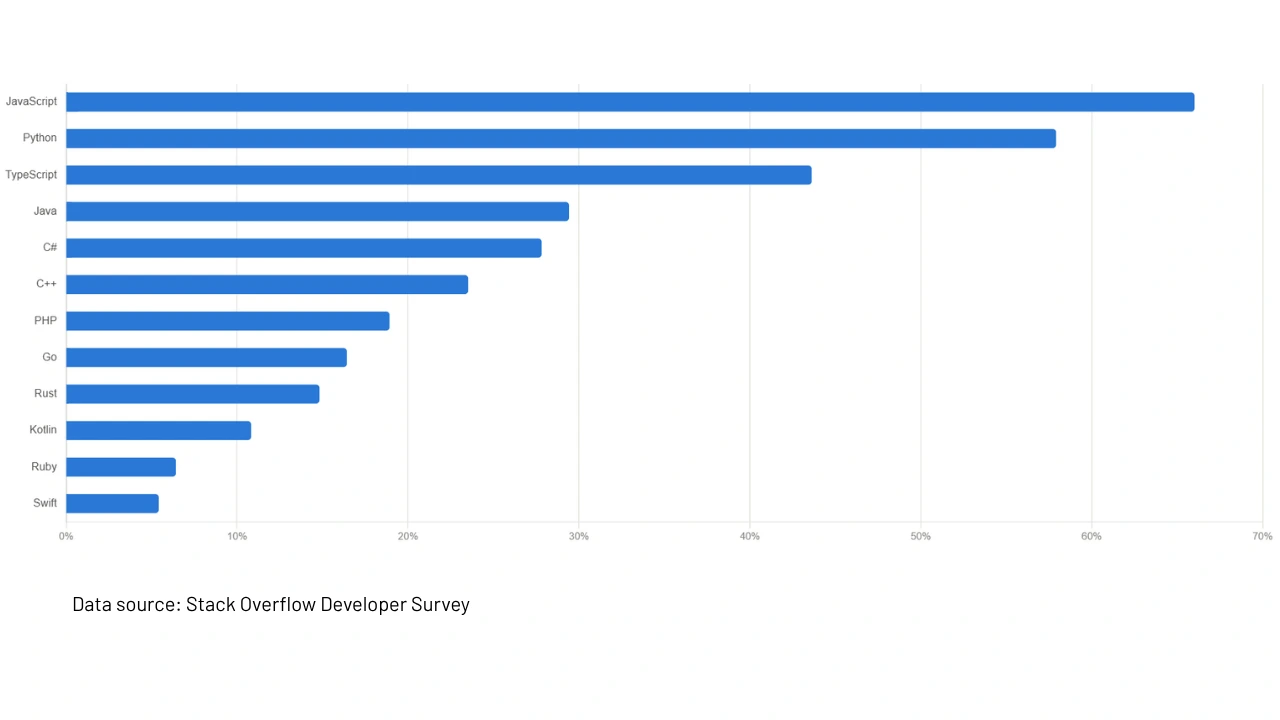
- JavaScript is the most widely used language, according to the Stack Overflow Developer Survey 2025. It is used by 66% of developers, followed by Python at 57.9%.
- TypeScript became the most-used language on GitHub, based on the GitHub Octoverse 2025 report. This shift reflects the rise of typed languages that support reliable, AI-assisted development.
- Python remains the most popular programming language on the TIOBE Index, holding the top spot into 2026. Its lead comes from strong demand in AI, data science, and automation, areas where Python is the standard choice.
Top 10 Programming Languages for 2026
The languages below rank among the most popular and most in-demand programming languages for custom software development. Each one has earned its place through real-world use, strong ecosystems, and steady demand from development teams.
1. Python
Python is a general-purpose programming language known for its clean, readable syntax and strong role in AI and data work. It has ranked among the leading programming languages for years, and that trend continues into 2026.
Its simple syntax makes development fast and code easy to maintain, which keeps project costs predictable. Python is the leading choice among top AI programming languages, supported by mature libraries such as TensorFlow, PyTorch, and scikit-learn. It also performs well in backend development and data analytics through frameworks like Django and FastAPI.
Pros:
- Clean syntax that speeds up development
- Rich libraries for AI, machine learning, and data science
- Strong community support and documentation
- Works across web, data, and automation projects
Where Python Is Used: Netflix, Dropbox, Instagram, and most AI and data science platforms.
2. JavaScript and TypeScript
JavaScript is the core programming language of the web, and it runs in every modern browser. TypeScript builds on JavaScript by adding type safety, which makes large applications easier to manage and less prone to errors.
Together, this pair powers most of the web today. JavaScript handles interactive features on the front end, while Node.js extends it to the back end for full-stack development.
TypeScript has grown quickly, and in August 2025, it overtook both JavaScript and Python to become the most-used language on GitHub by monthly contributors (Source: GitHub Octoverse). Much of this shift comes from teams using AI-assisted coding, where type safety helps catch errors that plain JavaScript would miss. Both languages are supported by major frameworks such as React, Angular, and Vue.
Pros:
- Runs on both front end and back end
- TypeScript adds type safety for large codebases
- Huge ecosystem of frameworks and libraries
- Strong support for real-time and interactive apps
Where JavaScript and TypeScript Are Used: Netflix, PayPal, LinkedIn, and most modern web and full-stack applications.
3. Java
Java is a general-purpose programming language built for large, reliable systems that need to run anywhere. Its “write once, run anywhere” design lets the same code work across different platforms without changes.
Created in the 1990s, Java has remained a top choice for enterprise software development for decades. It runs on the Java Virtual Machine, which gives it strong stability and cross-platform support. The language is backed by a mature ecosystem, led by the Spring framework for backend development. Java also powers a large share of Android apps and high-traffic systems. This keeps it among the most popular programming languages for enterprise builds in 2026.
Pros:
- Runs across platforms through the Java Virtual Machine
- Proven stability for large enterprise systems
- Mature ecosystem with strong framework support
- Scales well for high-traffic applications
Where Java Is Used: Airbnb, Spotify, Uber, and many enterprise and banking systems.
4. C#
Microsoft created C# to be a modern, object-oriented programming language for building secure and scalable applications. Today it sits at the center of the .NET ecosystem, which powers everything from enterprise web apps to popular games.
C# blends the power of C++ with a cleaner, easier syntax. It runs on .NET and ASP.NET Core, a fast and flexible platform for backend and web development. The language is also the foundation of the Unity game engine, which drives a large share of the world’s mobile and desktop games. Strong tooling and steady updates from Microsoft keep C# among the most used programming languages for enterprise work.
Pros:
- Deep integration with the .NET ecosystem
- Clean syntax that supports fast development
- Versatile across web, desktop, and game projects
- Strong performance and reliable Microsoft support
Where C# Is Used: Microsoft, Intuit, Stack Overflow, and many enterprise and game applications.
5. Go
Built by Google to handle work at a massive scale, Go is a programming language designed for speed, simplicity, and modern cloud systems. It keeps the syntax small and easy to read, which helps teams write reliable code faster.
Go stands out for how well it handles many tasks at once. Its built-in support for concurrency makes it ideal for backend services that serve high volumes of traffic. The language compiles quickly and deploys easily, which is why it has become a favorite for cloud-native development. Some of the most important tools in modern infrastructure, including Docker and Kubernetes, are written in Go. This keeps it among the top programming languages for cloud work.
Pros:
- Excellent performance for high-traffic systems
- Built-in support for concurrency
- Fast compilation and simple deployment
- Clean syntax that is easy to maintain
Where Go Is Used: Google, Uber, Cloudflare, and many cloud and microservices platforms.
6. Rust
Known for combining speed with safety, Rust is a low-level programming language built for performance-critical software. It gives developers fine control over memory without the common bugs that usually come with it.
Rust has topped developer satisfaction surveys for several years running. Its standout feature is memory safety without a garbage collector, which means fast execution and fewer crashes. This makes Rust a strong fit for systems software, where both speed and reliability are essential.
Pros:
- High performance close to C and C++
- Memory safety without a garbage collector
- Reliable for security-critical systems
- Growing ecosystem and strong developer community
Where Rust Is Used: Dropbox, Firefox, Cloudflare, and many systems and performance-critical applications.
7. PHP
Powering a large share of the websites online today, PHP is a server-side programming language made for web development. It runs the back end of countless sites, from small blogs to large platforms.
PHP has improved a great deal in recent years. Newer versions are much faster and more secure, which keeps the language relevant in 2026. Its biggest strength is the ecosystem around it, led by the Laravel framework for clean and modern backend development. PHP also runs WordPress, which powers a huge portion of the web. This makes it one of the most practical web development programming languages for content sites and online stores.
Pros:
- Purpose-built for web development
- Powers WordPress and major CMS platforms
- Modern frameworks like Laravel speed up builds
- Large hosting support and low running costs
Where PHP Is Used: WordPress, Slack, Facebook, and many content platforms and e-commerce sites.
8. Swift and Kotlin
Swift and Kotlin are the two leading programming languages for native mobile development. Swift is Apple’s official language for iOS, while Kotlin is Google’s preferred language for Android.
Both languages were built to be safe, fast, and easy to read. Swift powers high-performance apps across iPhone, iPad, and Mac, and it is usually the best language for iOS app development thanks to the SwiftUI framework and deep Apple support. Kotlin runs on the Java Virtual Machine and works smoothly with existing Java code, which makes it a natural choice for Android teams. Modern tools like Jetpack Compose make Kotlin development faster and cleaner. Together, they cover the full native mobile market, which keeps them among the top mobile programming languages.
Pros:
- Native performance on iOS and Android
- Safe and modern syntax that reduces errors
- Strong official support from Apple and Google
- Rich tooling with SwiftUI and Jetpack Compose
Where Swift and Kotlin Are Used: Instagram, Airbnb, Pinterest, and most native iOS and Android apps.
9. C++
C++ is a high-performance, low-level programming language built for speed and direct control over system resources. It lets developers manage memory and hardware closely, which makes it ideal for software where every millisecond counts.
C++ has been a core language for demanding systems for decades. It powers applications that need maximum performance, such as game engines, real-time systems, and high-frequency trading platforms. The Unreal Engine, one of the most widely used game engines in the world, is built on C++. The language also sits inside many operating systems, browsers, and embedded devices. This keeps C++ among the most used programming languages for performance-critical software today.
Pros:
- Top-tier performance and low-level control
- Direct memory and hardware management
- Proven choice for game engines and real-time systems
- Works well for embedded and resource-limited devices
Where C++ Is Used: Adobe, Unreal Engine, Microsoft, and many game and high-performance systems.
10. Ruby
Ruby is a high-level programming language known for clean, developer-friendly code, and Ruby on Rails is the framework that made it famous. They are built for one thing above all: getting working software to market quickly.
Rails follows a “convention over configuration” approach, which removes much of the repetitive setup work. This lets small teams build and launch full web applications at remarkable speed. That speed is why Ruby on Rails remains a favorite for startups and early-stage products. The language is mature and stable, with a rich library of ready-made components called gems.
Pros:
- Very fast development and quick time to market
- Clean syntax that is easy to read and maintain
- Rich library of ready-made gems
- Proven choice for MVPs and web startups
Where Ruby Is Used: Shopify, GitHub, Airbnb, and many startups and web platforms.
What Should You Consider When Choosing a Programming Language?
The best programming language is the one that fits your project, your team, and your long-term goals. The five factors below help you make that choice with confidence.
Project Type and Goals
Your project type should guide your language choice more than any trend. A data-heavy AI platform, a customer-facing web app, and a mobile product each call for different tools.
Start with the goal of the software. Python suits AI and data work, JavaScript fits interactive web apps, and Swift or Kotlin are right for native mobile. For many Singapore startups, the goal is a fast, market-ready product, which often points toward languages with quick development cycles.
Performance and Scalability
Some applications must handle heavy traffic and grow without slowing down. This matters for businesses planning to scale across Singapore and the wider Southeast Asian market.
Languages like Go, Rust, and Java are strong choices when performance and scalability are priorities. They handle high volumes of users and data with stability. For smaller tools or early-stage products, raw speed matters less, and faster development often takes priority.
Ecosystem and Libraries
A strong ecosystem can save months of development time. Mature languages come with ready-made libraries, frameworks, and tools that solve common problems out of the box.
As some of the most popular programming languages, Python, JavaScript, and Java all have rich ecosystems with wide community support. This means fewer features built from scratch and faster delivery. A healthy ecosystem also means better security updates and long-term reliability, which protects your investment over time.
Talent and Hiring Pool
The size of the local talent pool directly affects your cost, hiring speed, and long-term support. In Singapore, demand for hiring skilled developers is high, and talent competition is strong.
Popular languages such as Python, JavaScript, and Java have the largest developer pools in Singapore and Southeast Asia. This makes hiring easier and helps keep projects moving if your team changes. Niche languages can offer technical advantages, but they often come with a smaller talent pool and higher costs. Many Singapore businesses manage this gap by working with software development partners who already have skilled teams in place.
Long-Term Maintenance
Software needs care long after launch. The right language keeps maintenance simple, affordable, and sustainable for years.
Choose a language with stable updates, clear documentation, and an active community. Established languages tend to age well and remain easy to support. This is especially important for Singapore SMEs, where keeping long-term running costs under control is often a top priority.
How Is AI Changing Language Choice?
AI tools have become part of everyday development, and they are starting to shape which programming languages teams choose. The way developers write code in 2026 looks very different from just a few years ago.
The scale of this change is hard to ignore. 85% of developers now use AI tools for coding regularly (Source: JetBrains 2025 Developer Ecosystem Survey). AI coding assistants help write, review, and test code faster, which means the language a team picks now affects how well it works alongside these tools.
The languages that benefit most are the ones these assistants understand best. Because AI models learn from massive amounts of public code, they give sharper suggestions for widely used languages like Python and JavaScript than for niche ones. This is clearest with Python, which sits at the center of AI and machine learning development.
For businesses, the takeaway is simple. The safest choice is a language your developers know well, and your AI tools can support with confidence.
Read more: The Real Impact of AI on Software Development
How TechTIQ Solutions Picks the Right Language for Your Project
At TechTIQ Solutions, we never start with the language. We start with your business goal, then choose the programming language that best fits your custom software development project, your budget, and your plans for growth across Singapore and Southeast Asia.
Our developers work across the full range of modern programming languages and frameworks. This includes Python, JavaScript, Java, C#, PHP, Ruby on Rails, and C++, along with cross-platform mobile frameworks like React Native and Flutter. Because our expertise spans the entire stack, we match the right technology to each project rather than fitting every build into a fixed set of tools.
We also offer flexible engagement models so you can scale your team in the way that fits your business. Whether you need staff augmentation, a dedicated development team, or a longer-term offshore setup, you gain access to experienced developers across Singapore and Southeast Asia. This helps you control costs, hire faster, and keep your project moving at every stage.
Frequently Asked Questions (FAQs)
What is the difference between a programming language and a framework?
A programming language is the basic set of rules used to write code, while a framework is a ready-made structure built with that language to speed up development. For example, JavaScript is a language, and React is a framework built with it. Language gives you full control. A framework saves you time.
How many programming languages are there?
There are around 700 to 1,000 programming languages, depending on how you count them. Most estimates put the number of notable, actively used languages at about 250 to 700. The rest are experimental, academic, or no longer maintained. For custom software, only 15 to 20 languages are used regularly. (Source: Wikipedia)
What are the most in-demand programming languages in 2026?
The most in-demand programming languages in 2026 are Python, JavaScript, Java, C#, and Go. Python leads because of AI and data work. JavaScript dominates web development. Java and C# remain strong for enterprise systems. Go is rising fast for cloud and backend services.
What is the best programming language for a startup MVP?
For a startup MVP, the best languages are usually JavaScript, Python, and Ruby on Rails. They allow fast development and quick launches. Ruby on Rails is popular for building full web apps with small teams. The right choice still depends on your product type and goals.
Are old programming languages still worth using?
Yes, many old programming languages are still worth using. Languages like Java, C, C++, and PHP have been around for decades and remain reliable and widely supported. Their maturity means stable performance, strong documentation, and large talent pools, which makes them a safe choice for long-term projects.
What are the best programming languages to learn for a career?
The best programming languages to learn for a tech career are Python, JavaScript, and Java. Python is beginner-friendly and opens doors in AI and data. JavaScript is essential for web development. Java offers a strong, stable demand in enterprise software. All three have large job markets worldwide.
What programming language is used for AI?
Python is the main programming language used for AI. It leads because of mature libraries like TensorFlow, PyTorch, and scikit-learn, which speed up machine learning work. R is also used for data analysis and statistics. For high-performance AI systems, some teams add C++ or Java for speed.
Conclusion
The top programming languages each have clear strengths, but there is no single best one for every project. The right choice always depends on your goals, your timeline, and your plans for growth. For most businesses, the smartest move is not picking a language on your own. It is working with a team that understands the trade-offs and matches the right technology to your goals.
Ready to build your next software project in Singapore with the right technology? Talk to our team at TechTIQ Solutions today to find the best fit for your goals.


Related articles

What Is Inventory Management Software and How Does It Work?
 Wei Kiong Tan
  08 Aug 2026
Web Design vs Web Development: Which One Do You Need?
13 Jul 2026 
PoC vs MVP vs Prototype: What’s the Difference?
03 Jul 2026 
Top 10 .NET Development Companies in Singapore for 2026
23 Jun 2026 
Native Mobile App Development: Everything to Know in 2026
19 Jun 2026 
10 Web Security Best Practices for Singapore Startups and SMEs in 2026
15 May 2026 
10 Minimum Viable Product Examples for Startups That Want to Win Early
10 May 2026 
What Is Web Design? A Complete Guide for Businesses
07 May 2026 
50 Best App Ideas for Startups and Entrepreneurs to Build in 2026
02 May 2026 


