


PoC vs MVP vs Prototype: What’s the Difference?

 Updated on Oct 01, 2026
Choosing between a Proof of Concept (PoC), a Prototype, and a Minimum Viable Product (MVP) confuses many teams. Skip the wrong stage, and you risk wasting time and budget. Some founders jump straight to MVP without testing feasibility first. Others build a prototype and call it done. Then they discover the concept never worked.
The confusion around PoC vs MVP vs prototype costs real money and real time, especially for Singapore startups working with a tight runway and grant deadlines. TechTIQ Solutions breaks down each stage clearly. You will know exactly when to build a PoC, when to test a prototype, and when you are ready for a real MVP.
Get the order right, and you cut risk at every step of product development.
Key Takeaway
- Proof of Concept (PoC) tests if an idea is technically possible before any design or development work starts.
- Prototype shows how the product will look and feel, using clickable mockups instead of real code.
- Minimum Viable Product (MVP) delivers working features to real users to test market demand and gather feedback.
- Building all three stages in order cuts risk at each step: technical risk first, then design risk, then market risk.
What Is a PoC?
A PoC stands for proof of concept, and it answers one simple question: can this idea actually work?
PoC is not a product. It has no design and no user interface. It is a small test that checks if core technology is possible before anyone commits to building anything more.
For example, a fintech company wants to use blockchain for secure payments. They would build a PoC first to see if the blockchain can handle real transaction speed and security needs. It does not need a nice interface. It just needs to prove the tech works.
How a PoC Works
A proof of concept follows a focused process, and teams keep it small and fast so they can get an answer quickly.
Here is how it usually works:
- Pick one core technical assumption to test
- Build a minimal version that checks only that assumption
- Run the test in a controlled environment
- Review the results and decide if the idea is worth pursuing
The whole point is speed. You want an answer fast, before you spend real money on software development.
When to Use a PoC
Use a PoC when you are not sure if something is technically possible. This often applies to new technology or complex systems.
This step carries extra weight for Singapore businesses working in regulated sectors like fintech and healthtech. A PoC lets you test compliance-heavy features, such as PDPA-compliant data handling or MAS security requirements, before you invest in full development.
Good use cases include:
- Testing a new technology your team has never used
- Checking if a system can handle the expected load or traffic
- Validating a technical approach before committing budget
- Reducing risk on high-stakes or unproven ideas
- Confirming regulatory or compliance feasibility early, a common need for Singapore fintech and healthtech startups
If you skip this step, you might spend months building a product on a foundation that never works. This risk is even higher for SMEs with tight budgets because a failed build can set the whole roadmap back. PoC development protects you from that risk early.
What Is a Prototype?
A prototype is an early model of your product. It shows how the design looks and how it works.
What is a prototype exactly? Think of it as a draft. It can be simple sketches or a full clickable design. Either way, it lets you see the product before you build it.
A prototype shows how something will look and feel, while a proof of concept proves that an idea can function at all. That distinction sits at the core of the prototype vs PoC comparison.
How a Prototype Works
Designers build a prototype using tools like Figma or Adobe XD. These tools create realistic mockups. Users can click through screens just like a real app.
The process usually follows these steps:
- Sketch the basic layout and user flow
- Turn sketches into a clickable digital model
- Test the model with real users or stakeholders
- Collect feedback and refine the design
This step catches design problems early. Fixing a screen flow in a prototype costs far less than fixing it after development starts.
When to Use a Prototype
Use a prototype when you need to test design and user experience. It works best after you know the idea is technically possible.
For Singapore startups and SMEs, this step matters even more. The local market moves fast, and competitors launch new apps and platforms every month. A prototype lets you validate your app ideas with real users before you spend a limited runway on full development.
Teams often show a prototype to stakeholders before writing any code. This step gathers feedback fast, and it also helps when you pitch to investors or apply for grants like the Enterprise Development Grant (EDG). A working prototype gives evaluators something concrete to see, not just a slide deck.
Prototypes are generally created to answer one key question: does this design work for users? They help you:
- Test navigation and user flow
- Get feedback from stakeholders early
- Spot design flaws before development
- Save time and money on costly rebuilds
A prototype does not need real backend logic. It only needs to look and feel real enough for people to react to it. This is why the prototype vs MVP comparison matters. An MVP delivers working features. A prototype only shows the experience.
What Is an MVP?
MVP is short for minimum viable product, a working version of your product with only the core features included.
While earlier stages focus on feasibility and design, an MVP puts a real, functional product in front of real users. This is where you find out if people actually want what you built.
Instagram started as Burbn, a location-sharing app with too many features. The team stripped it down to one core function: sharing photos with filters. That stripped-down version became the MVP that grew into Instagram. It had no messaging and no stories, just the core experience that users wanted, a pattern you can see across other MVP examples from successful startups.
An MVP is not the final product. It is the smallest version that still delivers real value, and it exists to answer one question: will people actually use this?
How an MVP Works
Building an MVP means cutting features down to only what matters most.
Here is how the process usually works:
- List every possible feature for your product
- Rank features by how much value they deliver to users
- Keep only the features needed for the product to work
- Launch to a small group of real users
- Collect feedback and use it to guide the next version
The goal is not to build something perfect. The goal is to learn what your market actually wants and then build on that.
Read also: How To Create Minimum Viable Product For Your Digital Application
When to Use an MVP
Develop an MVP when you already know your idea is technically possible and your design has been tested. This is the stage where you find out if the market wants what you built.
For Singapore startups and SMEs, this stage often lines up with fundraising and grant milestones. Investors and programs like Startup SG Founder want to see traction, not just a pitch deck. A working MVP with real user data gives you proof that goes beyond promises.
Good use cases include:
- Launching to early adopters to gather real usage data
- Testing pricing models with paying customers
- Validating product-market fit before scaling
- Building a track record to support fundraising or grant applications
- Learning which features to prioritize based on actual behavior
If you launch too early, you may waste resources on features nobody wants. Otherwise, if you launch too late, a competitor might beat you to market. Our MVP development services help you find that balance, especially in Singapore’s fast-moving startup scene.
PoC vs MVP vs Prototype: What’s the Difference?
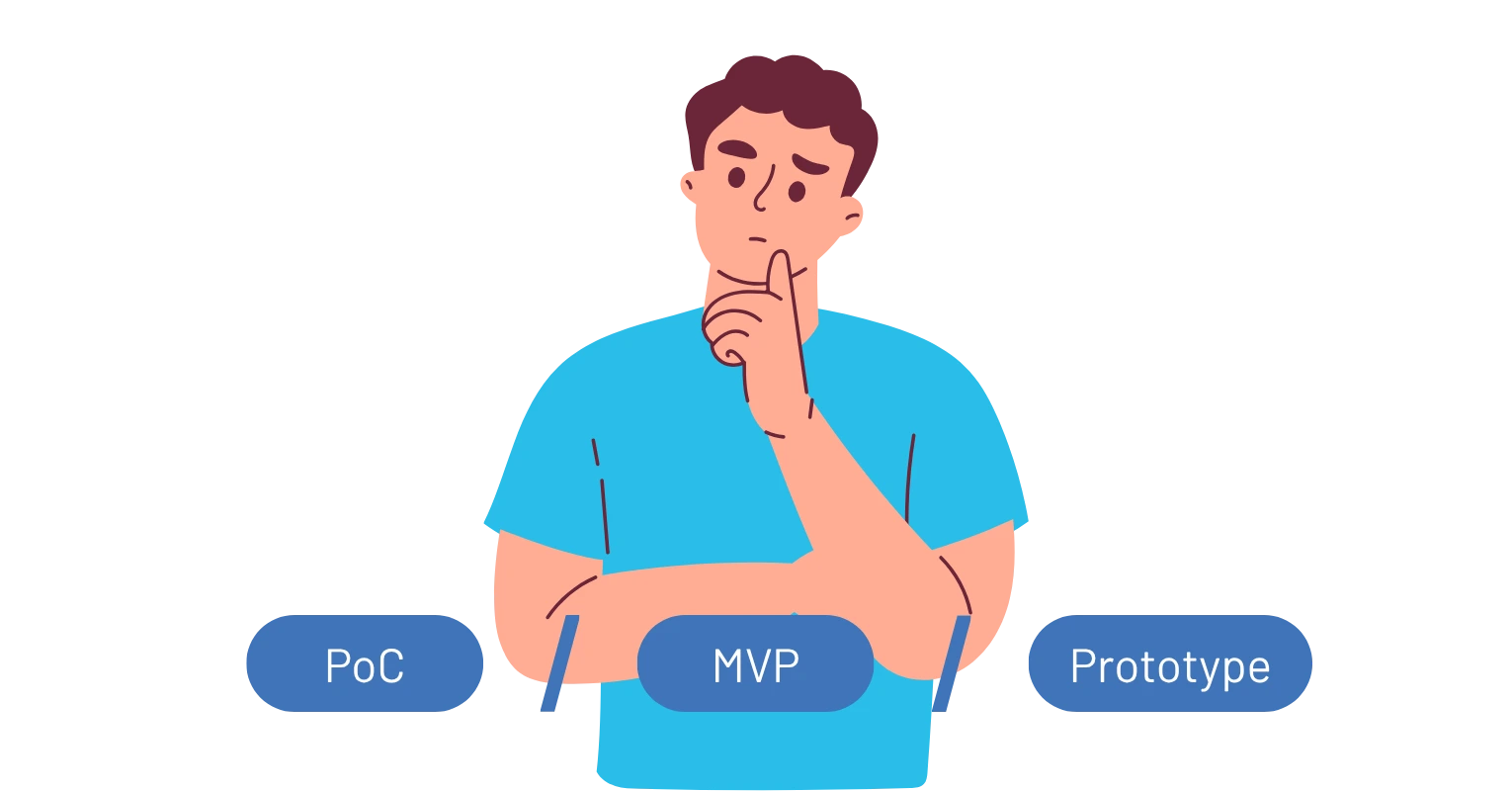
Prototype vs Proof of Concept vs MVP sit at different points in the product development journey. A PoC and a prototype both belong to the pre-product stage, and they usually need only a small budget and a short timeline.
An MVP moves you into a different stage. Instead of testing an isolated question, you are now building a real product with working features, ready for real users to try. This shift means an MVP takes more time, more budget, and more resources than a PoC or a prototype.
The table below breaks down how these three stages compare across purpose, audience, output, cost, and timeline.
| Parameter | PoC | Prototype | MVP |
| Purpose | Validate technical feasibility | Visualize design and user flow | Test market demand and gather user feedback |
| Key Question | Can this be built? | Does this design work for users? | Will people actually use this? |
| Audience | Internal technical team | Stakeholders and design team | Early adopters and real users |
| Output | Functional experiment, no UI | Interactive design model, no backend | Working product with core features |
| Cost | SGD 3,000 to SGD 15,000 | SGD 5,000 to SGD 20,000 | SGD 20,000 to SGD 80,000+ |
| Timeline | Days to weeks | Weeks | Weeks to months |
| Validation Focus | Technical feasibility | Usability and user experience | Market fit and user adoption |
| Risk Evaluation | Reduces the risk of technical problems | Reduces the risk of user dissatisfaction | Reduces the risk of building a product with no market |
| Revenue | Not for sale | Not for sale, but can attract further investment | Sells to early adopters and can generate investment |
Costs vary widely based on project complexity, industry, and the number of features involved. A PoC for a simple technical test costs far less than one involving advanced AI or blockchain integration.
A PoC answers the feasibility question and reduces risk before real development begins. Since it stays internal and skips the interface entirely, it rarely helps you pitch to investors or show off financial potential. Once you know the tech works, a prototype becomes your next move if you want to show how the product will look and feel without building it.
A prototype skips the business logic behind the scenes, but it demonstrates the interface and user flow clearly enough for people to react to it. Share it with a focus group, and you can spot gaps in the experience before writing a single line of production code. This also makes a prototype useful for winning early investor interest, since stakeholders can see and click through something real.
An MVP takes things further with actual working features that support your core business idea. It is still far from the finished product, but it gives you something real users can try, which means you collect actual usage data instead of guessing. That data then guides which features to refine, cut, or build out next.
This is really what the PoC vs prototype vs MVP comparison comes down to.
- The PoC vs prototype distinction is about proof versus presentation; one confirms the tech works and the other shows how it feels to use.
- The prototype vs minimum viable product gap is about depth. A prototype only simulates the experience while an MVP delivers it.
- In the PoC vs MVP comparison, the difference is timing and purpose, a PoC proves something can be built, while an MVP proves people want it.
None of these three stages compete with each other. They build on one another, and skipping one usually means paying for it later, either in wasted budget or a product nobody wants.
How to Pick the Right Approach for Your Singapore Startup
PoC, prototype, and MVP are not interchangeable choices. Each one fits a different stage of your product journey and answers a different question, which is exactly why the PoC vs MVP vs prototype debate confuses so many founders.
The right pick depends on what you are still unsure about. If technical feasibility is the concern, start with a PoC. If user experience needs testing, build a prototype. If you are ready to see whether the market wants your product, launch an MVP.
Getting this order right can save real time and money down the line, especially when your next milestone depends on it.
PoC, Prototype, or MVP: Real Use Cases in Practice
Here is where the proof of concept vs prototype vs MVP comparison gets practical, with real scenarios that show exactly when each stage fits.
PoC works best when:
- Your idea depends on new or unproven technology
- You are not sure yet if the concept is technically feasible
- Two or more technical approaches are on the table, and you need to pick one
- Your team needs a shared, tested understanding of the technical direction
Prototype works best when:
- You need something concrete to walk stakeholders through the user flow
- Investors or grant reviewers want to see the idea, not just hear about it
- Feedback from a focus group would shape the design before development starts
- The deadline is tight, and a working demo beats a slide deck
MVP works best when:
- Real users, not just your team, need to validate demand for this
- You want to launch fast without letting development costs run away
- Early revenue is part of the plan, not an afterthought
- The biggest risk left is whether the market actually wants this product
Working through all three stages is not a must. But for Singapore startups and SMEs with limited runway and tight grant deadlines, this quick list makes it easier to see which stage fits right now, so you can skip straight to it when the earlier stages do not apply.
Wrapping Up
PoC, prototype, and MVP each prove something different. A PoC confirms the idea can technically work. A prototype turns that idea into something people can see, touch, and react to. An MVP goes furthest, putting real features in front of real customers to see if they actually stick around.
Need help deciding between MVP vs PoC vs prototypes or building the right custom software solution for your Singapore startup? TechTIQ Solutions has guided founders through each of these stages, from early technical testing to MVP launches that attract real users. We turn early ideas into products ready for the market.
Contact us today to talk through which stage fits your project.
Frequently Asked Questions (FAQs)
When should a business use a PoC instead of an MVP?
Use a PoC when you are not sure if the idea is technically possible. It fits new or unproven technology, complex integrations, or high-risk concepts. An MVP comes later, once you know the tech works and you are ready to test real market demand.
What is the role of user feedback in MVP development?
User feedback guides every decision after an MVP launches. It shows which features people actually use, which ones they ignore, and what problems still need to be solved. Teams use this feedback to refine the product before investing in full-scale development.
Proof of Principle vs Proof of Concept: Is there a difference?
Yes. A proof of principle tests a narrow scientific or technical concept in theory, often without a working system. A proof of concept goes further and builds a small, working test to confirm an idea can function in practice. The terms are related but not interchangeable.
How does a Pilot compare to PoC, prototype, and MVP?
A Pilot comes after the MVP stage. While PoC, prototype, and MVP test feasibility, design, and core market demand, a Pilot tests the full product in a real, limited-scale setting before a wider launch. In the PoC vs MVP vs Pilot comparison, the Pilot carries the least technical risk but the highest stakes, since it closely mirrors a real launch.
What comes after a proof of concept in the product development cycle?
After a PoC confirms technical feasibility, most teams move to a prototype to test design and user flow. Once the design holds up, the next step is an MVP, which puts real features in front of real users to test market demand.
How long does each stage usually take?
A PoC usually takes days to a few weeks, since it only tests one technical assumption. A prototype takes a similar range, often a few weeks, depending on how detailed the design needs to be. An MVP takes the longest, from several weeks to a few months, because it involves real development and testing with actual users.


Related articles
What Is Inventory Management Software and How Does It Work?
 Wei Kiong Tan
  08 Aug 2026
Web Design vs Web Development: Which One Do You Need?
13 Jul 2026 
Top 10 Programming Languages for Software Development in 2026
27 Jun 2026 
Top 10 .NET Development Companies in Singapore for 2026
23 Jun 2026 
Native Mobile App Development: Everything to Know in 2026
19 Jun 2026 
10 Web Security Best Practices for Singapore Startups and SMEs in 2026
15 May 2026 
10 Minimum Viable Product Examples for Startups That Want to Win Early
10 May 2026 
What Is Web Design? A Complete Guide for Businesses
07 May 2026 
50 Best App Ideas for Startups and Entrepreneurs to Build in 2026
02 May 2026 


