


Agentic AI vs Generative AI: What Is the Difference?

 Updated on Oct 01, 2026
Business leaders in Singapore keep hearing about agentic AI and generative AI, often in the same sentence. The two technologies sound alike, share the same large language model foundation, and appear together in nearly every vendor’s pitch. This makes it difficult to decide which one actually fits the problem they are trying to solve.
The cost of that confusion is high. Companies buy generative AI tools when they need autonomous workflows or invest in agentic AI when a simple content generator would do the job. Budgets stretch thin, projects stall, and ROI is never achieved.
When comparing agentic AI vs generative AI, consider agentic AI as proactive and generative AI as reactive. Generative AI creates content, while agentic AI takes action. Both are useful, and they solve very different problems.
At TechTIQ Solutions, we help businesses across Singapore design and deploy both types of AI systems. This guide breaks down the difference between agentic AI and generative AI in plain terms, with practical use cases for the Singapore market.
Agentic AI vs Generative AI: A Quick Comparison
Generative AI is reactive and creates content when prompted, while agentic AI is proactive and pursues goals with little human input. Both are forms of artificial intelligence built on large language models, but they solve very different problems for the business.
Consider generative AI as a skilled assistant that produces an output, such as a blog draft, a code snippet, or a summary, whenever you prompt it. Agentic AI behaves more like a digital coworker that is responsible for an outcome, breaking a goal into steps, calling the tools it needs, and reporting back when the job is done. The two often work together, with generative AI handling the creation and agentic AI handling the execution.
The table below shows the agentic AI vs generative AI differences in a single view, covering behavior, output, autonomy, and risk.
| Dimension | Generative AI | Agentic AI |
| Core behavior | Reactive. Responds to a prompt. | Proactive. Pursues a goal. |
| Primary output | Content (text, code, images, audio) | Actions and completed tasks |
| Autonomy level | Low. Needs a prompt for each output. | High. Plans and executes multiple steps. |
| Tool use | Stays inside the model | Calls APIs, databases, and other systems |
| Best for | Single tasks like drafting or summarizing | Multi-step workflows like research or operations |
| Human role | Reviews and edits every output | Sets the goal and approves key checkpoints |
| Main risk | Hallucinated or off-brand content | Wrong actions taken without oversight |
What Is Generative AI?
Generative AI (GenAI) is a type of artificial intelligence that creates new content, such as text, images, code, audio, or video, in response to a user’s prompt.
It learns patterns from large datasets and uses those patterns to produce original outputs that resemble human-made work. Popular examples include ChatGPT, Gemini, Claude, Midjourney, and GitHub Copilot.
Generative AI runs on large language models (LLMs) or other foundation models trained on billions of data points. The model does not look up a fixed answer from a database. Instead, it predicts what should come next based on your prompt, whether that next thing is a word, a pixel, or a sound, and builds the output piece by piece until the response is complete.
How Generative AI Works
Generative AI works by predicting what comes next based on patterns learned during training, rather than retrieving fixed answers from a database. The model breaks your prompt into small units called tokens, runs them through a neural network with billions of parameters, and generates the response one token at a time until the output is complete.
A foundation model like GPT-4, Claude, or Gemini is trained on massive datasets of text, code, and images. During training, the model adjusts its internal weights billions of times to learn the statistical patterns of language and visual data. By the end, the model has built a deep grasp of how words, ideas, and structures fit together, even though it does not “know” facts the way a database does. This is why generative AI output sounds fluent but can sometimes invent details, a behavior known as hallucination.
What Is Agentic AI?
Agentic AI is a type of artificial intelligence that can plan, decide, and act on its own to reach a goal with little human input.
Instead of waiting for a prompt for every single step, an agentic AI system breaks a goal into smaller tasks, picks the right tools for each task, and works through the entire process from start to finish.
Examples include autonomous customer service agents, AI coding assistants that build full features, and enterprise workflow agents that handle research, reporting, and operations.
Agentic AI combines a large language model with planning logic, memory, and a set of tools it can call, such as APIs, databases, search engines, or other software systems. The LLM acts as the reasoning engine that decides what to do next, while the tools allow the agent to carry those decisions out. This is where the line between agentic AI vs. generative AI becomes clear in practice.
How Agentic AI Works
Agentic AI works through a continuous loop of perceive, reason, act, and learn. The system accepts a high-level goal and figures out the rest on its own. A large language model sits at the center as the reasoning engine, with a set of connected tools that allow the agent to take action in real systems.
At each step, the agent reads the current state, evaluates progress against the goal, picks the best next action, calls the right tool, and reviews the result before moving on. This cycle repeats until the goal is reached or a human checkpoint pauses the workflow. The agent is not following a fixed script. It makes decisions in real time based on what is happening, which is what gives agentic AI its autonomy.
Features of Generative AI vs Agentic AI
Now that we have covered what each technology is, let’s look at the features that make them stand out. The sections below break down the key features of generative AI vs agentic AI side by side and clear up the confusion around AI agents while we are at it.
Key Features of Generative AI
- Content generation capability: Produces new text, code, images, audio, and video based on patterns learned during training, rather than retrieving pre-written answers from a database.
- Prompt-based input: Operates on a single-turn input model where each output depends entirely on the prompt provided by the user.
- Foundation model architecture: Built on large language models or diffusion models trained on massive datasets, giving the system broad general knowledge across many topics.
- Reactive behavior: Responds only when prompted and stops once the output is delivered, with no ability to call APIs, query databases, or run tasks on its own.
- Stateless interactions: Has no built-in memory of past prompts unless that history is manually included in the current input.
Key Features of Agentic AI
- Goal-oriented behavior: Accepts a high-level objective as input and generates its own plan to reach it, instead of waiting for step-by-step instructions.
- Autonomous decision-making: Selects the next action at each step using reasoning, context, and real-time data, without requiring human input for routine choices.
- Tool and system integration: Connects to external APIs, databases, search engines, and business applications to perform actions in the real world.
- Memory and context retention: Retains information from earlier steps in the same task, which allows the agent to build on past actions and adapt its plan over time.
- Multi-step task execution: Chains multiple actions together in a loop of perceive, reason, act, and learn to complete complex workflows end to end.
Agentic AI vs AI agents
People often confuse agentic AI vs AI agents, but they are not the same. An AI agent is a single software entity that can sense its environment, make decisions, and take action. Agentic AI is the broader system or approach that gives one or more agents the ability to plan, reason, and pursue goals with real autonomy.
An AI agent is the individual unit that performs the work, while agentic AI is the broader system that defines how that work is planned and carried out. A modern agentic AI system often uses several AI agents at once, with each agent owning a specific part of the workflow. This is the level at which the AI agent vs agentic AI vs generative AI distinction matters most. Each one plays a different role in the stack. Generative AI writes the email, the AI agent sends it, and the agentic AI system decides why and when the email should be sent.
Benefits of Agentic AI and Generative AI for Singapore Enterprises
Both generative AI and agentic AI bring real business value, but the kind of value each one delivers is quite different.
The sections below break down the main benefits of generative AI vs. agentic AI so Singapore enterprises can see where the ROI shows up.
Benefits of Generative AI
Generative AI delivers value by reducing the manual workload in content-driven and knowledge-driven tasks. Here are the main benefits enterprises see when they adopt it well.
- Faster content production: Reduces the time required to draft blogs, ads, product copy, and reports from days to minutes. Marketing and content teams can then focus on strategy.
- Lower operational costs: Handles work that used to need extra hires or outside agencies, so teams can scale output without increasing headcount.
- Personalization at scale: Tailors emails, product descriptions, and chat replies to each customer in real time. This improves engagement and conversion rates across diverse customer bases.
- Faster software development: Helps engineers write, review, and document code. The result is shorter release cycles and fewer bugs in production.
- Easier access to knowledge: Extracts insights from large documents or knowledge bases in seconds, so employees spend less time searching and more time deciding.
Benefits of Agentic AI
Agentic AI extends the capability further by automating full workflows from start to finish. The benefits below are what make it a strong fit for enterprises looking to move past simple automation.
- End-to-end workflow automation: Handles multi-step business processes on its own and removes the manual handoffs that slow teams.
- Smarter decision-making: Uses real-time data and reasoning to select the best next action at every step, so the system adapts when the situation changes.
- 24/7 operational coverage: Operates across time zones without breaks. This is a significant advantage for customer service, monitoring, and regional operations based in Singapore.
- Higher employee productivity: Takes over repetitive admin work like research, reporting, and data entry. This helps smaller local teams accomplish more in a tight talent market.
- Faster time to value: Completes complex jobs in hours instead of weeks and accelerates sales cycles, support resolution, and back-office operations.
Use Cases for Generative AI vs Agentic AI in Singapore
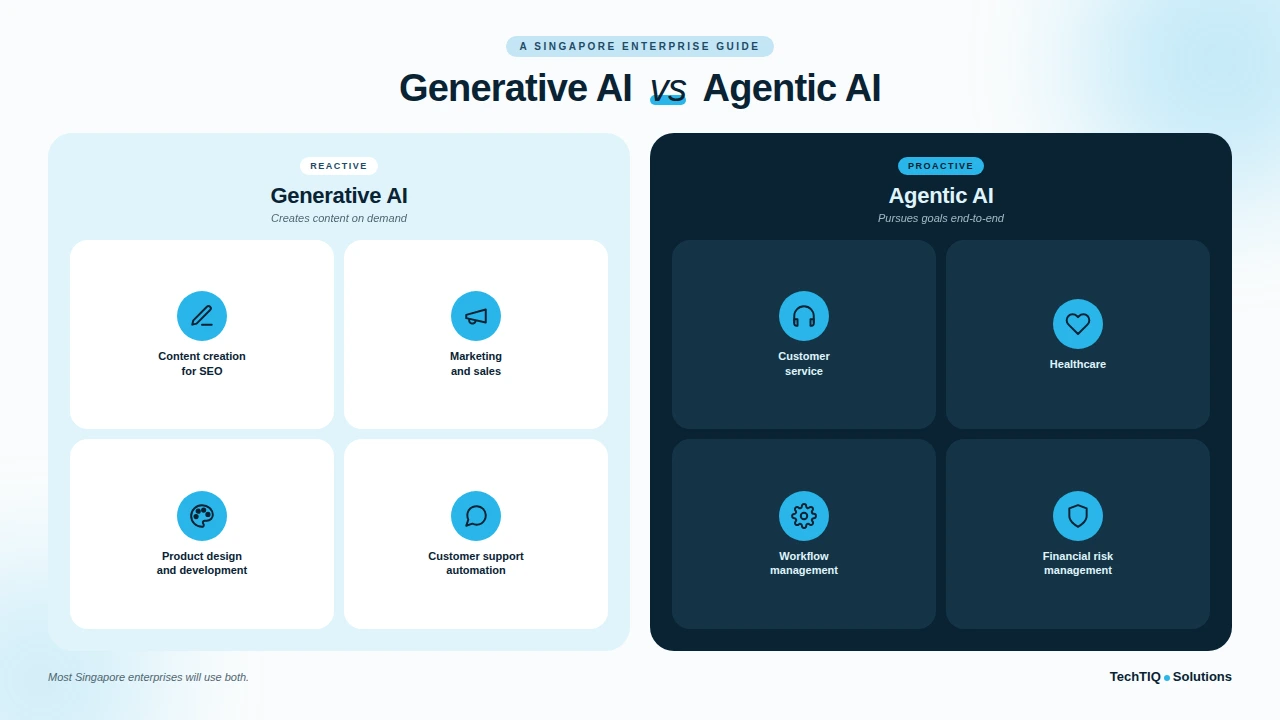
Looking at agentic AI vs generative AI use cases is the best way to see how the two technologies differ in practice. The use cases below show where each technology performs best and how the two often work together inside the same business.
Generative AI Use Cases
Generative AI fits best in tasks that revolve around creating, drafting, or summarizing content. Below are four of the most common generative AI use cases enterprises rely on today.
Content creation for SEO
Marketing teams use generative AI to write blog posts, meta descriptions, product pages, and social copy at a speed that would not be possible manually. The model handles the initial draft, and human writers refine the voice and add the strategic direction. This is one of the clearest agentic AI vs generative AI examples in action. The AI creates the content while a human is responsible for the final decision on what to publish.
For Singapore brands selling across ASEAN, the same workflow can produce content in multiple languages without hiring a larger content team.
Marketing and sales
Sales and marketing teams rely on generative AI to personalize emails, write ad variations, build pitch decks, and create call scripts in seconds. Sales reps can input a customer profile into the tool and receive a tailored outreach message ready to send within minutes. The result is more conversations, shorter sales cycles, and a significantly reduced content workload for marketing teams running regional campaigns based in Singapore.
Product design and development
Designers and product teams use generative AI to generate ideas, sketch UI mockups, write user stories, and produce sample code for prototypes. Work that previously required a full sprint of revisions can now happen within a single afternoon. Technology accelerates early-stage thinking without replacing the human judgment that decides which idea is worth building. This matters for small product teams trying to release products faster in a competitive market.
Customer support automation
Support teams integrate generative AI with chatbots and help-desk tools to answer common questions, write replies, and summarize long tickets for agents. The model handles routine questions in English, Mandarin, or Malay, while human agents focus on the cases that require a person. This increases support capacity and maintains short response times, even during high-demand periods such as major sales events.
Agentic AI Use Cases
Agentic AI performs best in jobs that involve many steps, multiple systems, and decisions that change as new information comes in. Below are four high-impact agentic AI use cases enterprises are deploying right now. Each one is a common starting point for an AI agent development project.
Customer service
Companies use agentic AI to manage complete customer service workflows from start to finish, not just answer one question at a time. The agent can pull up a customer record, check order status, process a refund, update the CRM, and send a follow-up email all in a single workflow. This is where the agentic AI vs generative AI in commerce difference becomes evident. The agent does not just talk to the customer but actually resolves the customer’s issue.
Singapore retailers and telcos are already testing this approach to reduce backlog and improve first-contact resolution.
Healthcare
Healthcare providers use agentic AI to book appointments, flag urgent cases, pull patient history, and prepare notes for doctors before a visit. The agent works across the patient record system, the scheduling tool, and the messaging platform without a human connecting the steps manually. Doctors get cleaner data and more time with patients, while admin teams reduce paperwork by hours each week. This is especially useful in Singapore’s busy clinic and hospital networks.
Automated workflow management
Operations teams use agentic AI to handle internal workflows like onboarding new hires, processing expense claims, or running supplier checks. The agent initiates each step, transfers data between systems, follows up on approvals, and reports back when something requires human review.
For Singapore SMEs adopting AI through EDG grants, this is often the first project that delivers measurable ROI. The savings on time and administrative work become visible within the first few months.
Financial risk management
Banks and fintech firms use agentic AI to monitor transactions, flag suspicious patterns, pull supporting data, and draft case files for analysts. The agent operates continuously and responds the moment a risk signal appears. A human team can never match this at scale.
Singapore banks have publicly shared how they use AI to scan transactions for fraud and money-laundering patterns at scale, with DBS among the most active in deploying AI across its risk and compliance functions. Analysts then review the flagged cases. This keeps human judgment in the loop where it is most important and supports compliance with MAS expectations on accountability in financial AI deployments.
Agentic AI and Generative AI Trends in 2026
The AI landscape moves fast, and the agentic vs generative AI debate looks different in 2026 than it did even a year ago. This is the year both technologies move from pilot projects to production systems inside the enterprise.
The trends below show where each technology is heading and what Singapore businesses should prepare for in the months ahead.
Generative AI Trends
Generative AI is no longer just about writing text or generating images. The technology is becoming more capable, more efficient, and more deeply built into the tools businesses already use.
- Multimodal models go mainstream: Models now handle text, images, audio, and video together in a single prompt. Marketing, design, and product teams can move from idea to multi-format output without switching tools.
- Smaller and more efficient models: Compact models that run on local hardware or private cloud are gaining traction. This matters for Singapore enterprises subject to PDPA and MAS data residency requirements.
- Domain-specific fine-tuning: Off-the-shelf models are being fine-tuned for specific industries such as finance, healthcare, and legal services. The output is more accurate, more relevant, and easier to defend in regulated sectors.
- Deeper integration into business software: Generative AI is now built into productivity suites, CRMs, and ERP platforms. Employees use it inside the tools they already work in, rather than switching to a separate chatbot.
- Tighter governance and guardrails: Hallucination control, source attribution, and content provenance are becoming standard features. Frameworks such as IMDA’s AI Verify give enterprises a clearer way to test and validate model behavior before deployment.
Agentic AI Trends
Agentic AI is moving from experimental demos to real production deployments. The trends below highlight where the technology is gaining ground and where Singapore enterprises are focusing their AI investments.
- Multi-agent systems become the norm: Single agents are giving way to teams of specialized agents that work together on complex tasks. One agent handles research, another writes, another reviews, and a coordinator agent manages the workflow end-to-end.
- Agentic AI built into enterprise platforms: Major software vendors are shipping agentic features inside their core products. Sales, service, HR, and finance teams now have access to agents that act inside existing systems without custom development.
- Vertical agents for regulated industries: Industry-specific agents for banking, healthcare, and legal services are emerging quickly. These agents come pre-loaded with domain knowledge and compliance guardrails, which shortens the path to deployment.
- Stronger human-in-the-loop controls: Enterprises are demanding clearer checkpoints, audit logs, and approval gates before agents take consequential actions. This is especially important in Singapore, where MAS expectations on accountability shape how financial services adopt AI.
- Rise of agentic AI governance frameworks: Regulators around the world, including IMDA and MAS, are publishing guidance specific to autonomous AI systems. Enterprises that align early with these frameworks will move faster and face fewer surprises during audits.
Adopting Agentic AI and Generative AI in Singapore
Singapore has positioned itself as one of Asia’s most AI-ready economies, with a clear national strategy, active government support, and a business community that moves quickly on new technology. The country’s National AI Strategy 2.0, launched in 2023, set out an ambition to triple Singapore’s AI talent pool and expand the number of practitioners working on real-world deployments. For local enterprises, this is the right moment to move from AI experimentation to serious adoption.
The business case is strong, and understanding the generative AI vs agentic AI difference helps Singapore enterprises pick the right tool for each problem. Companies face a tight labor market, rising costs, and pressure to serve customers across multiple languages and time zones. Generative AI addresses the content and knowledge bottlenecks that slow teams, while agentic AI takes on the repetitive workflows that drain productivity. Together, they help enterprises scale output and respond faster to market changes without expanding headcount at the same rate.
The biggest opportunity for most Singapore enterprises sits inside their core business systems. Modern enterprise software development is no longer about building static applications. It is about embedding intelligence directly into the systems that run the business. Generative AI brings smarter content, search, and personalization into CRMs, ERPs, and customer platforms, while agentic AI automates full workflows across them. Enterprises that build AI into their software early will move faster than those that try to bolt it on later.
Key Takeaway
- Generative AI is reactive and creates content, such as text, code, images, and audio, in response to a user’s prompt.
- Agentic AI is proactive and acts, breaking a goal into steps and executing multi-step workflows with little human input.
- Both technologies run on large language models but solve different problems, and most enterprises use them together inside the same systems.
- Generative AI delivers value through faster content production, personalization at scale, and easier access to knowledge across marketing, sales, support, and software development.
- Agentic AI delivers value through end-to-end workflow automation, 24/7 operational coverage, and smarter decision-making across customer service, healthcare, finance, and operations.
- Singapore enterprises gain a strong advantage by combining both technologies with local funding schemes such as EDG and PSG, and by aligning with PDPA, MAS, and IMDA frameworks.
How TechTIQ Solutions Can Help
The choice between agentic AI vs generative AI is not about picking a winner. Generative AI creates the content, the code, and the insights that move work forward, while agentic AI carries out the multi-step workflows that move the business forward. Most Singapore enterprises will end up using both inside the same systems, and the companies that adopt early will set the pace for the rest of the market.
Choosing the right partner is just as important as choosing the right technology. TechTIQ Solutions brings together AI expertise, enterprise software experience, and a deep understanding of the Singapore market. Our AI and machine learning services cover the full lifecycle, from strategy and use case selection to model selection, system integration, and post-deployment support. We work with local enterprises across financial services, healthcare, retail, and software-driven industries to design and deploy AI systems that deliver measurable business outcomes.
To explore how agentic AI and generative AI can fit into your business, contact us to start the conversation.
FAQs
How does traditional AI vs generative AI vs agentic AI compare?
The traditional AI vs generative AI vs agentic AI comparison comes down to how each one handles input and output.
Traditional AI follows fixed rules and decision trees to perform a single task, such as classifying an email or flagging a transaction. Generative AI creates new content based on patterns learned during training. Agentic AI plans, decides, and acts across multi-step workflows on its own.
The agentic AI vs generative AI vs traditional AI progression reflects how the field has evolved, from rule-based systems to content creation, and now to autonomous action.
Which industries benefit most from agentic AI and generative AI in Singapore?
Industries that benefit most from agentic AI and generative AI in Singapore include financial services, healthcare, retail and e-commerce, logistics, professional services, and software development. Generative AI is widely used for content, marketing, and customer support, while agentic AI is gaining ground in fraud detection, customer service automation, and workflow management across regulated sectors.
How can Singapore SMEs fund their AI adoption?
Singapore SMEs can fund AI adoption through government schemes such as the Enterprise Development Grant (EDG) and the Productivity Solutions Grant (PSG). These grants help offset the cost of consulting, software, and implementation for approved AI projects. SMEs that plan deployments carefully and work with experienced AI partners often see faster ROI and a smoother path through PDPA and other local compliance requirements.
How much does it cost to implement agentic AI or generative AI for an enterprise?
The cost of implementing agentic AI or generative AI varies based on use case complexity, data readiness, and integration scope. Simple generative AI deployments, such as chatbots or content tools, can start in the low five figures in SGD, while enterprise-grade agentic AI systems that connect to multiple business platforms typically run higher. Most Singapore enterprises see ROI within 6 to 12 months when the project scope is well defined.
How long does it take to deploy an agentic AI or generative AI solution?
Deployment timelines for agentic AI and generative AI depend on the use case and the state of your existing systems. A focused generative AI pilot can typically go live in a matter of weeks, while a production-grade agentic AI workflow that connects to multiple business platforms usually takes several months. Strong data foundations and clear business goals are the two factors that most affect speed to deployment.
What is the difference between generative AI vs agentic AI vs predictive AI?
The agentic AI vs generative AI vs predictive AI comparison comes down to what each one is designed to do. Predictive AI analyzes historical data to forecast future outcomes, such as customer churn or fraud risk. Generative AI creates new content based on patterns it learned during training. Agentic AI takes autonomous action across multi-step workflows.
Many enterprise systems combine all three: predictive AI for forecasting, generative AI for content and communication, and agentic AI for execution.


Related articles
AI ERP in Singapore 2026: What It Is and How It Works
 Bruce Pham
  30 Sep 2026
10 Best AI Coding Assistant Tools In 2026
22 Jun 2026 
AI Chatbot for Education: A Complete Guide for Singapore Institutions
23 Apr 2026 
The Real Impact of AI on Software Development
19 Apr 2026 
Generative AI Development in Singapore: Complete Guide
11 Aug 2025 


